
-
Customer Mails & Inquiry
kp@onellaexport.com
-
Opening Times
08:00 AM - 08:00 PM
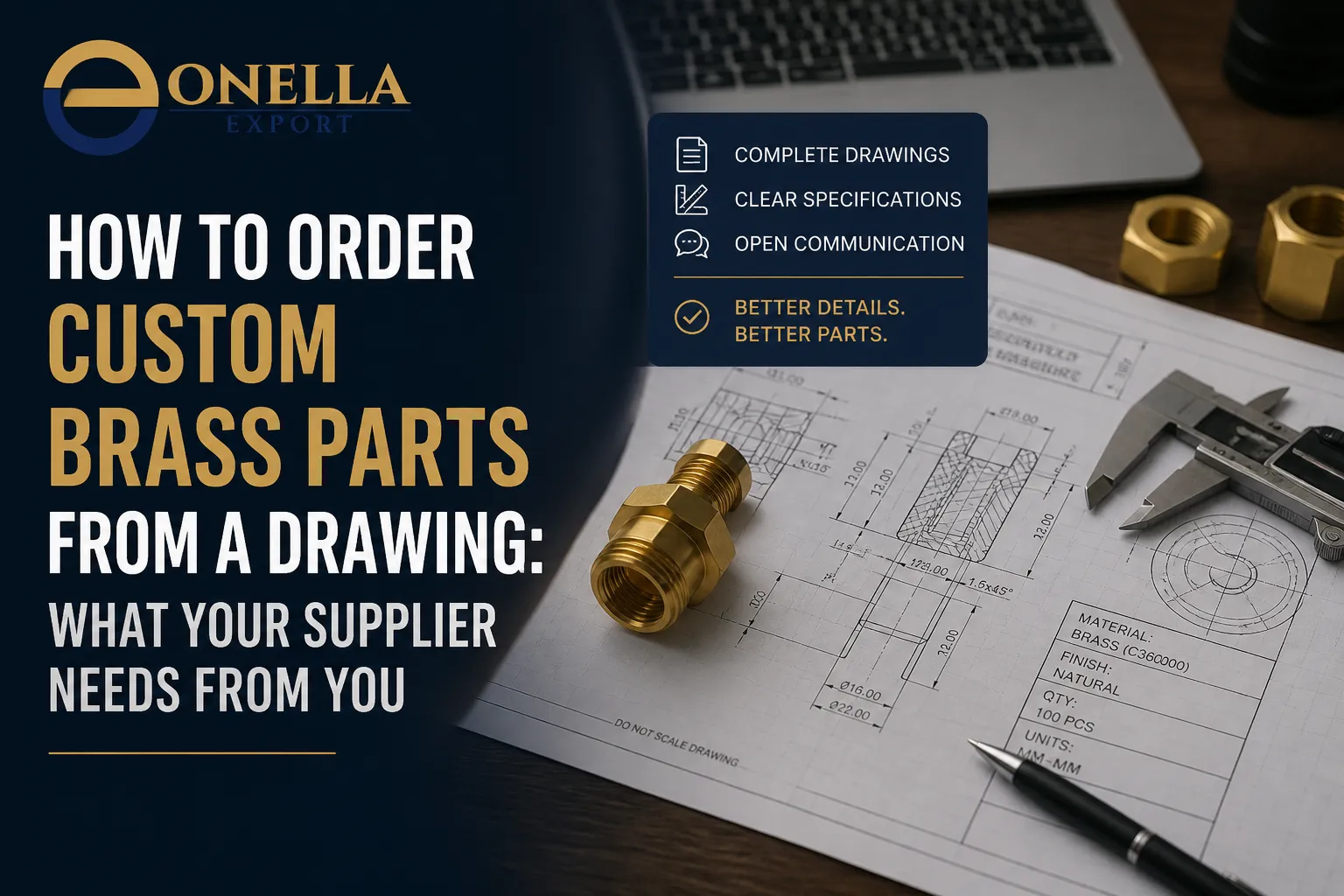
Every custom order starts the same way: someone sends a file and hopes the manufacturer on the other end understands exactly what's needed. More often than people expect, that hope is misplaced, not because the manufacturer is careless, but because the drawing itself left out something critical.
This guide covers what actually needs to be in a drawing, or what to prepare if you don't have one, before you finalize making the order from a reliable custom brass components supplier, so the quote you get back is accurate and the part you receive matches what you had in mind.
Why Drawing Quality Determines Quote Accuracy
A vague drawing produces a vague quote, and a vague quote almost always gets revised once production actually starts, usually at a cost or delay nobody budgeted for. Manufacturers price based on what they can see.
Missing tolerances, unclear thread callouts, or ambiguous material specs force them to either guess, which creates risk for both sides, or ask follow-up questions, which slows the whole process down. The sharper the brass parts as per drawing, the faster and more accurate everything downstream becomes.
The Non-Negotiables Every Drawing Should Include
Dimensions and Tolerances
Every critical dimension needs a tolerance attached, not just a target measurement. A dimension without a tolerance leaves the manufacturer to apply their own standard default, which may be tighter or looser than what your application actually requires. If a particular feature is load-bearing or affects a mating part, flag it specifically rather than assuming it's obvious from context.
Material Grade and Finish
"Brass" alone isn't a specification; it's a starting point. Different alloy grades vary in hardness, machinability, and corrosion resistance, and the right one depends on your application's mechanical and environmental demands. Finish matters too: natural, plated, polished, since it affects both appearance and, in some cases, functional performance like conductivity or wear resistance.
Thread Specifications
If your brass component includes any threaded feature, specify the exact standard, such as BSP, NPT, or metric, along with the required pitch and class. Thread callouts are one of the most frequent omissions in custom technical drawings and one of the most expensive to fix after production begins. Clear specification up front prevents costly rework, fitting failures, and assembly delays.
What If You Only Have a Physical Sample, Not a Drawing?
Plenty of buyers come to a manufacturer with a worn or existing part rather than a formal drawing, and that's a completely workable starting point. A capable manufacturer can measure the sample, reverse-engineer the dimensions, and produce a working drawing for your approval before committing to production.
If this is your situation, mention it upfront. Include any known specifications you do have, even partial ones, since that narrows the reverse-engineering work considerably and speeds up the first quote.
How Manufacturers Turn a Drawing Into a Working Quote
Once a drawing lands on a manufacturer's desk, a few things typically happen before a quote goes out. They review the geometry for machinability, flagging any features that would be difficult or costly to produce as drawn. They confirm material availability for your specified grade. They calculate tooling or setup requirements if the part needs custom fixturing.
Only after this review does a realistic quote, covering both cost and lead time, get put together. Skipping or rushing this stage is usually where inaccurate quotes come from.
Common Drawing Gaps That Delay Production
A handful of recurring issues show up across most custom orders that stall partway through:
- Missing or inconsistent tolerance callouts on critical dimensions.
- No surface finish specification, leaving it open to interpretation.
- Thread details given as "standard" without naming the actual standard.
- Conflicting dimensions between different views of the same drawing.
- No indication of which features are critical versus cosmetic.
Catching these before production starts, rather than after a batch comes back wrong, saves both time and material cost.
Getting From First Draft to Final Approval
The smoothest custom orders tend to follow a clear sequence: drawing submission, manufacturer review and clarifying questions, a revised or confirmed drawing, a sample production run, buyer approval of the sample, and then full production. Skipping the sample stage to save time is tempting on small orders, but it's usually where mismatches get caught cheaply, before they're baked into a full production batch.
Setting Expectations for Revisions and Sign-Off
It's worth agreeing upfront on how revisions will be handled if the first sample doesn't match expectations. Will a second sample be produced at no extra cost if the issue traces back to a manufacturer error? What happens if the original drawing was ambiguous and the manufacturer interpreted it differently than intended?
A capable custom brass components supplier will walk through this process with you before production starts, not leave it as an unresolved question that surfaces only if something goes wrong.
Turn Your Drawings into Precision-Crafted Brass Components
Transitioning from a detailed technical drawing to high-volume manufacturing requires an experienced production partner who values precision as much as you do. By establishing strict tolerance specs, clear material grades, and structured prototype sign-offs early, you eliminate costly redesigns and keep your supply chain running without delays.
At Onella Export, a growing custom brass components supplier, we specialize in transforming complex engineering blueprints into flawless custom brass parts. Whether you need initial sample validation or full-scale OEM manufacturing, our technical team works closely with you through every step of the revision and approval process.
Ready to bring your designs to life? Upload your CAD drawings today to request a fast, competitive quote, or contact our engineering experts to review your custom specifications.
Frequently Asked Questions
Can a manufacturer quote without a tolerance on every dimension?
Yes, but they'll apply a default tolerance standard, which may not match your actual requirement. Specifying critical tolerances avoids this guesswork.
How long does reverse-engineering from a physical sample typically take?
It depends on part complexity, but most manufacturers can produce a working drawing for approval within a few days of receiving the sample.
Is a sample production run necessary for small custom orders?
It's strongly recommended even for small orders, since catching a mismatch at the sample stage is far cheaper than discovering it in a completed batch.
Related articles
- Why Jamnagar Is India's Brass Parts Hub, and What That Means for Global Buyers
- How to Choose a Brass Ball Valve Manufacturer in India: 7 Checks Before You Order
- Brass vs Aluminium Stop Plugs: Which Is Right for Your Pipeline?
- Why Brass Is the Preferred Metal for Electrical Components (and What to Ask Your Supplier)
- All Onella Export articles