
-
Customer Mails & Inquiry
kp@onellaexport.com
-
Opening Times
08:00 AM - 08:00 PM
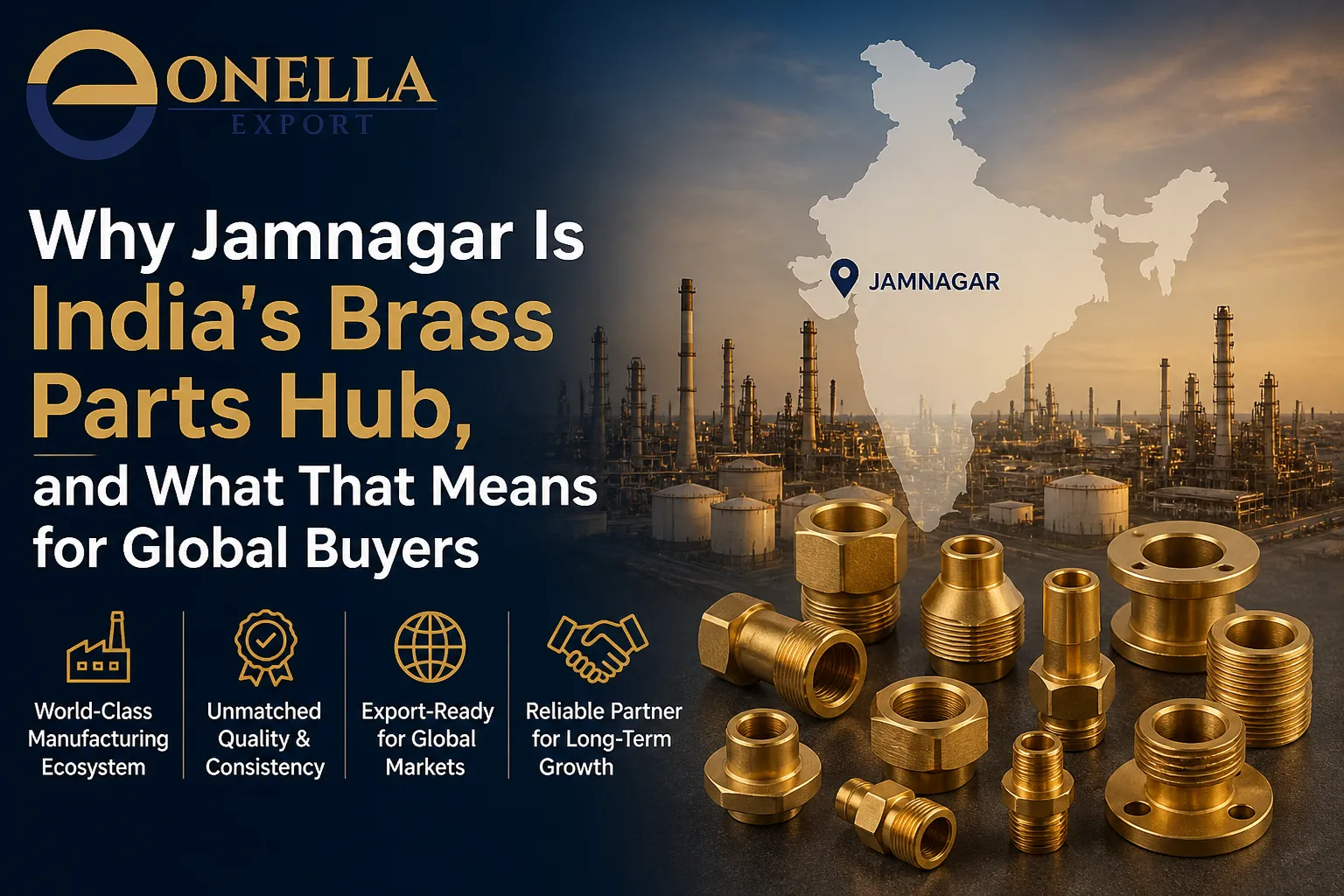
Ask anyone in the global brass components trade where the serious manufacturing happens, and one city comes up often. Jamnagar, on India's western coast in Gujarat, didn't earn that reputation through marketing. It earned it through decades of concentrated manufacturing expertise that's difficult to replicate elsewhere.
This blog explains how that happened and what it practically means for buyers evaluating a brass components manufacturer Jamnagar based, versus sourcing from a less established region.
How a Single City Became Synonymous With Brass Manufacturing
Jamnagar's brass industry traces back generations, starting with small regional workshops producing basic hardware components for domestic buyers. Over decades, that foundational base evolved into a comprehensive, highly integrated industrial ecosystem. Today, raw material foundries, high-precision machine shops, specialized plating facilities, and international export houses operate within close geographic proximity to one another.
This extreme industrial density represents Jamnagar's true competitive advantage. Rather than relying on a single massive factory attempting to handle every step internally, the region operates as a coordinated industrial network. Generations of specialized focus have refined supply chains, optimized machining processes, and eliminated operational inefficiencies, making the city a premier global hub for custom brass manufacturing and export.
What Makes Jamnagar's Ecosystem Different From Other Regions
Concentration of Skilled Machining Labor
Generations of brass manufacturing means generations of machinists who grew up around this specific trade. That depth of hands-on experience is difficult to shortcut. Workers in Jamnagar's brass sector often bring years of specialized skill that newer manufacturing regions, however well-equipped, simply haven't had time to accumulate.
Established Raw Material Supply Chains
Because so much brass production happens in one concentrated area, raw material suppliers set up specifically to serve that demand, offering more consistent alloy quality and faster procurement than manufacturers in regions without that same supply density nearby.
Decades of Export Experience
Jamnagar-based manufacturers have shipped internationally for a long time, which means documentation processes, quality certification, and freight logistics are well-practiced rather than improvised. For buyers importing for the first time, this experience reduces a lot of the friction that comes with working with a newer, less export-focused supplier.
The Practical Advantage for Buyers Sourcing at Scale
For buyers placing large or recurring orders, Jamnagar's concentrated industrial ecosystem delivers distinct operational benefits. Immediate access to local raw material foundries eliminates supply chain bottlenecks, preventing production stalls when raw material demand spikes.
Furthermore, a deep regional talent pool of skilled machinists enables manufacturers to scale production volumes rapidly without sacrificing precise dimensional tolerances or surface finish quality.
Market density also plays a crucial role in cost optimization. Direct competition among localized machine shops, foundries, and finishing plants keeps pricing fair and transparent across all production stages.
Ultimately, high-volume buyers gain a dependable sourcing environment that balances scalable manufacturing capacity, predictable delivery schedules, and highly competitive unit economics over long-term procurement cycles.
What to Expect When Working With a Jamnagar-Based Manufacturer
Buyers sourcing from Jamnagar benefit from working with partners deeply familiar with global technical expectations. Whether you require custom hardware, turned fittings, or high-volume brass sanitary components, regional manufacturers routinely handle international thread standards like BSP, NPT, or metric alongside complex finish specifications, minimizing lengthy initial technical consultations. Furthermore, export compliance is deeply integrated into daily operations. Established suppliers generate key documentation, including material test reports, commercial invoices, and certificates of origin, with minimal friction or administrative oversight required from buyers.
High regional production capacity ensures shorter lead times on standard catalog items and routine components. While specialized, custom-machined parts still demand dedicated tooling lead times, the region's overall operational baseline delivers faster communication, superior batch consistency, and greater overall processing efficiency compared to less established manufacturing hubs worldwide.
Questions Worth Asking Regardless of Location
Before evaluating supplier options, whether in Jamnagar or elsewhere, global buyers should ask critical operational questions to ensure quality, consistency, and compliance:
- What quality verification and material testing protocols are standard? Request chemical composition reports and batch-level dimensional inspection data to confirm compliance with your technical specifications.
- How are international thread standards and surface finish tolerances maintained? Verify that tooling and machining processes consistently meet exact specifications (e.g., BSP, NPT, or metric threads) across high-volume production runs.
- What is the typical lead time for custom tooling versus standard catalog items? Clarify baseline manufacturing timelines and batch consistency before placing orders to ensure your supply chain schedules stay on track.
- How are export compliance and cross-border documentation handled? Confirm that essential shipping paperwork such as material test reports and certificates of origin is generated routinely without administrative delays.
Why Location Still Matters in a Global Sourcing Decision
Manufacturing location isn't just geography; it reflects the surrounding infrastructure, labor expertise, and supply chain maturity a manufacturer has access to. A manufacturer operating within Jamnagar's ecosystem benefits from all of that groundwork without needing to build it independently.
For global buyers comparing suppliers across different regions, that context is worth factoring in alongside the standard checks of certification, sample quality, and communication, since it often explains why two seemingly similar manufacturers can differ significantly in consistency and reliability at scale.
Trusting the Right Jamnagar Manufacturer
Choosing the right supply chain partner is the difference between constant operational friction and seamless, scalable growth. While Jamnagar offers an unmatched ecosystem for precision brass component manufacturing, realizing these advantages requires a partner dedicated to international quality benchmarks, rigorous testing, and transparent delivery schedules.
At Onella Export, we bridge the gap between world-class Indian manufacturing and your exact global engineering standards. Contact our technical sourcing team today to request custom samples, evaluate our detailed material certs, or discuss your upcoming custom tooling requirements.
Frequently Asked Questions
Is Jamnagar brass automatically higher quality than brass from other regions?
Not automatically, but the concentration of skilled labor and established supply chains generally supports more consistent quality at scale compared to less developed manufacturing regions.
Does sourcing from Jamnagar reduce shipping complexity for international buyers?
Sourcing from a reliable supplier like Onella Export in Jamnagar often helps, since we are experienced with export documentation and international shipping processes, reducing common delays tied to inexperienced exporters.
Do Jamnagar manufacturers typically handle both small and bulk export orders?
Yes, most established manufacturers in the region handle a range of order sizes, though lead times and MOQs vary depending on the specific component and manufacturer.
Related articles
- How to Choose a Brass Ball Valve Manufacturer in India: 7 Checks Before You Order
- Brass vs Aluminium Stop Plugs: Which Is Right for Your Pipeline?
- Why Brass Is the Preferred Metal for Electrical Components (and What to Ask Your Supplier)
- Brass Molding Inserts: How They Improve Mold Life and Cycle Time
- All Onella Export articles