
-
Customer Mails & Inquiry
kp@onellaexport.com
-
Opening Times
08:00 AM - 08:00 PM
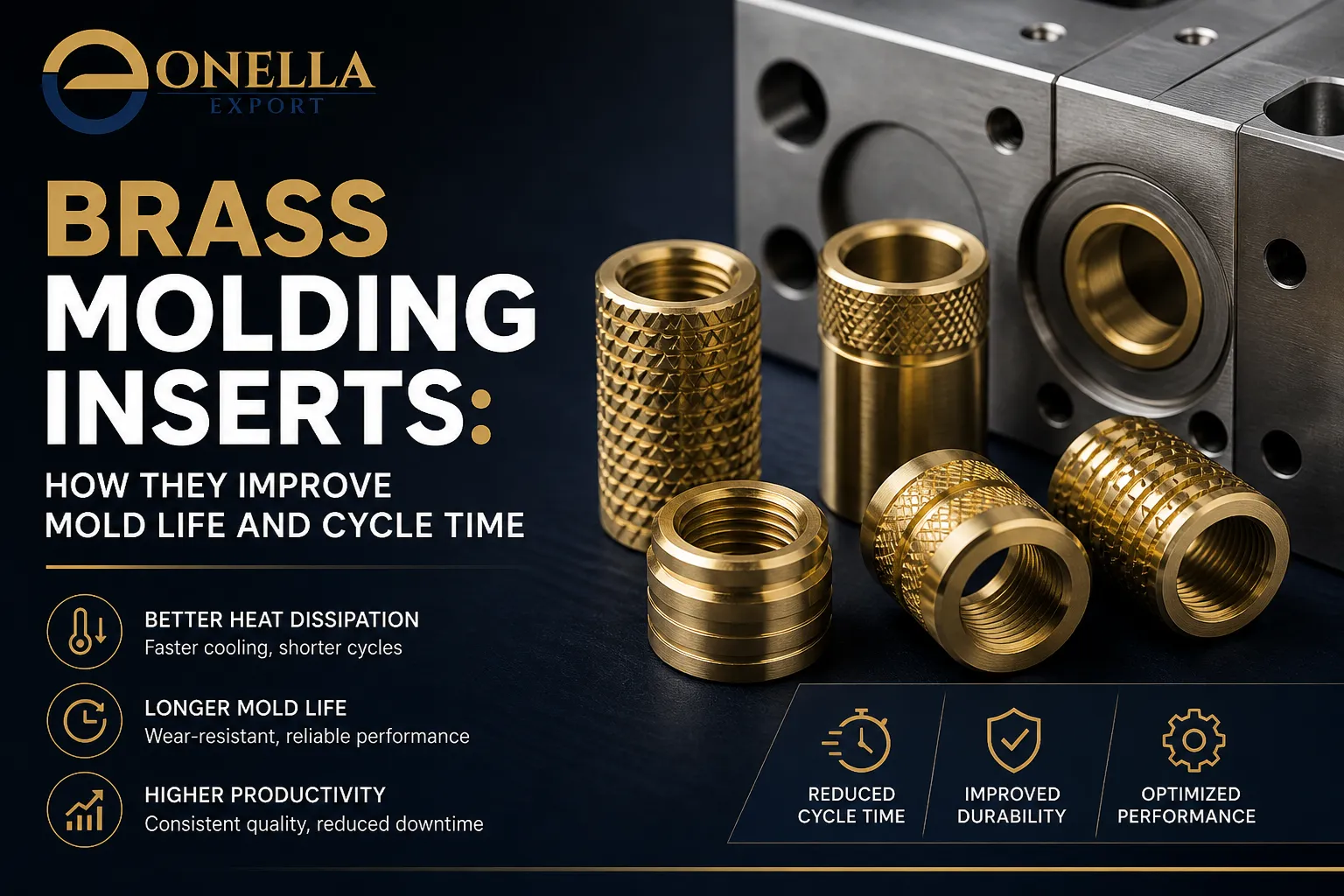
A mold can be engineered perfectly and still underperform if the inserts inside it are working against it rather than with it. Heat doesn't leave a cavity fast enough, cycle times creep up, and nobody traces the slowdown back to something as unglamorous as insert material.
This blog looks at how brass inserts actually affect mold life and cycle time, and what separates a capable brass insert for plastic molding manufacturer from one that's just machining shapes to spec without understanding the thermal side of the job.
The Overlooked Component That Decides Mold Performance
Inserts rarely get the attention the mold base or the injection system does, yet they sit at the exact point where molten material meets metal. Every cycle, they absorb heat, release it, and do it again, thousands of times over the life of a production run.
A mismatch here, wrong alloy, poor machining, shows up slowly, not as a sudden failure but as gradually declining part quality and widening cycle times nobody immediately connects to the insert.
Heat Transfer: Where Brass Actually Earns Its Keep
Brass conducts heat considerably faster than tool steel. That single property changes more than people expect.
Faster heat dissipation means the cavity cools sooner, the part solidifies sooner, and the mold is ready for the next shot sooner. Multiply that saved time across a production run of tens of thousands of cycles, and the difference stops being marginal. It becomes a measurable line item in your production cost per part.
Cycle Time Savings, Broken Down
The savings don't come from one single factor, they stack:
- Faster heat extraction shortens the cooling phase of each cycle.
- Smoother cavity surfaces reduce friction during ejection, speeding up part release.
- Lower insert temperature at the start of each cycle means less thermal lag before the next shot begins.
None of these individually feels dramatic. Together, across a long production run, they add up to real throughput gains that a steel-only mold setup often can't match.
The Unit Cost Impact: Quantifying Cycle Time Savings
Shorter cooling times directly improve machine utilization and production efficiency. In high-volume injection molding, cooling typically consumes 60% to 70% of total cycle time. Reducing a 30-second cycle by just 3 to 5 seconds via optimized brass thermal dissipation increases hourly output by 10% to 15%.
This extra capacity lowers machine hour rates per part, decreases operator labor costs, and defers capital expenditure on additional mold cavities. Over a multi-thousand unit run, these marginal efficiency gains convert directly into measurable profit margin improvements.
Mold Life: Why Inserts Wear Differently Than You'd Expect
It's a common assumption that a softer metal wears out faster. In practice, brass inserts hold up well precisely because they're not fighting the thermal cycle the way steel does.
Steel inserts expand and contract more aggressively under repeated heating and cooling, and that stress accumulates as micro-fatigue over time.
Brass handles that thermal cycling with less internal stress, which, counterintuitively, often means a longer functional life for the insert despite being a "softer" metal on paper.
Enhancing Wear Resistance with Surface Coatings and Plating
Standard brass performs exceptionally well with unfilled polymers, but highly abrasive engineering resins like glass-filled nylon can cause premature surface erosion. To maintain dimensional accuracy without sacrificing thermal speed, high-performance inserts undergo specialized surface treatments.
Electroless nickel plating or physical vapor deposition (PVD) coatings create an ultra-hard barrier that protects the cavity surface against abrasive fiber wear and corrosive off-gassing. This surface enhancement preserves fine details and prolongs insert life during demanding production runs while retaining the superior heat dissipation benefits of the underlying brass core.
Detail Reproduction in Complex Cavities
Thin Ribs and Fine Features
Molds with intricate detailing, thin ribs, fine textures, tight radii, benefit from brass's machinability. It cuts cleanly enough to reproduce detail that would require significantly more machining time and tooling wear if attempted in hardened steel.
Draft Angles and Ejection
Getting draft angles right affects how cleanly a part releases from the cavity. Brass's smoother finish after machining reduces drag during ejection, which lowers the chance of surface marking on cosmetic parts and reduces wear on ejector components over time.
What to Look for in a Brass Insert for Plastic Molding Manufacturer
Not every manufacturer approaches insert production the same way, and the differences matter more than buyers often realize going in. A few things worth checking before placing an order:
Does the manufacturer select alloy grade based on your expected cycle count, or do they default to one standard grade regardless of application? Can they machine directly from a CAD file, and do they understand draft angle and parting line requirements well enough to flag issues before production rather than after? What's their actual turnaround on a trial insert versus a full production set?
A manufacturer who asks about your molding material and expected cycle volume before quoting is usually one who understands the thermal side of the job, not just the machining side.
When Brass Inserts Aren't the Right Call
Brass isn't the universal answer. Extremely high-volume production runs, well into the millions of cycles, sometimes favor hardened steel inserts despite the slower heat dissipation, simply because steel's wear resistance under that scale of repeated mechanical stress can outlast brass over the very long term.
For most mid-to-high volume runs though, brass's thermal advantage outweighs that tradeoff, and the cycle time savings alone often justify the choice. The right call depends on your specific production volume, part geometry, and how much cycle time actually matters to your cost structure.
Ready to optimize your mold life and reduce cycle times? Contact Onella Export today for custom precision brass inserts!
Frequently Asked Questions
Do brass inserts work for both prototype and full production molds?
Yes, brass suits both. Prototyping benefits from faster machining turnaround, while production runs benefit from the ongoing heat dissipation and cycle time advantages brass provides.
Can brass inserts be reworked or re-machined if a design changes?
Yes, brass's machinability makes rework comparatively straightforward, whether adjusting a dimension or reworking a cavity detail after an initial production trial.
What cycle volume makes brass inserts the practical choice over steel?
Brass generally suits low to high-volume runs well. Extremely high-volume production, well beyond typical runs, is where steel's wear resistance may become the deciding factor instead.
Related articles
- Brass Pipe Fittings Guide: BSP vs NPT Threads and How to Specify Them
- Importing Brass Components from India: A Buyer's Guide to MOQ, Lead Time and Documentation
- How to Order Custom Brass Parts From a Drawing: What Your Supplier Needs From You
- Why Jamnagar Is India's Brass Parts Hub, and What That Means for Global Buyers
- All Onella Export articles