
-
Customer Mails & Inquiry
kp@onellaexport.com
-
Opening Times
08:00 AM - 08:00 PM
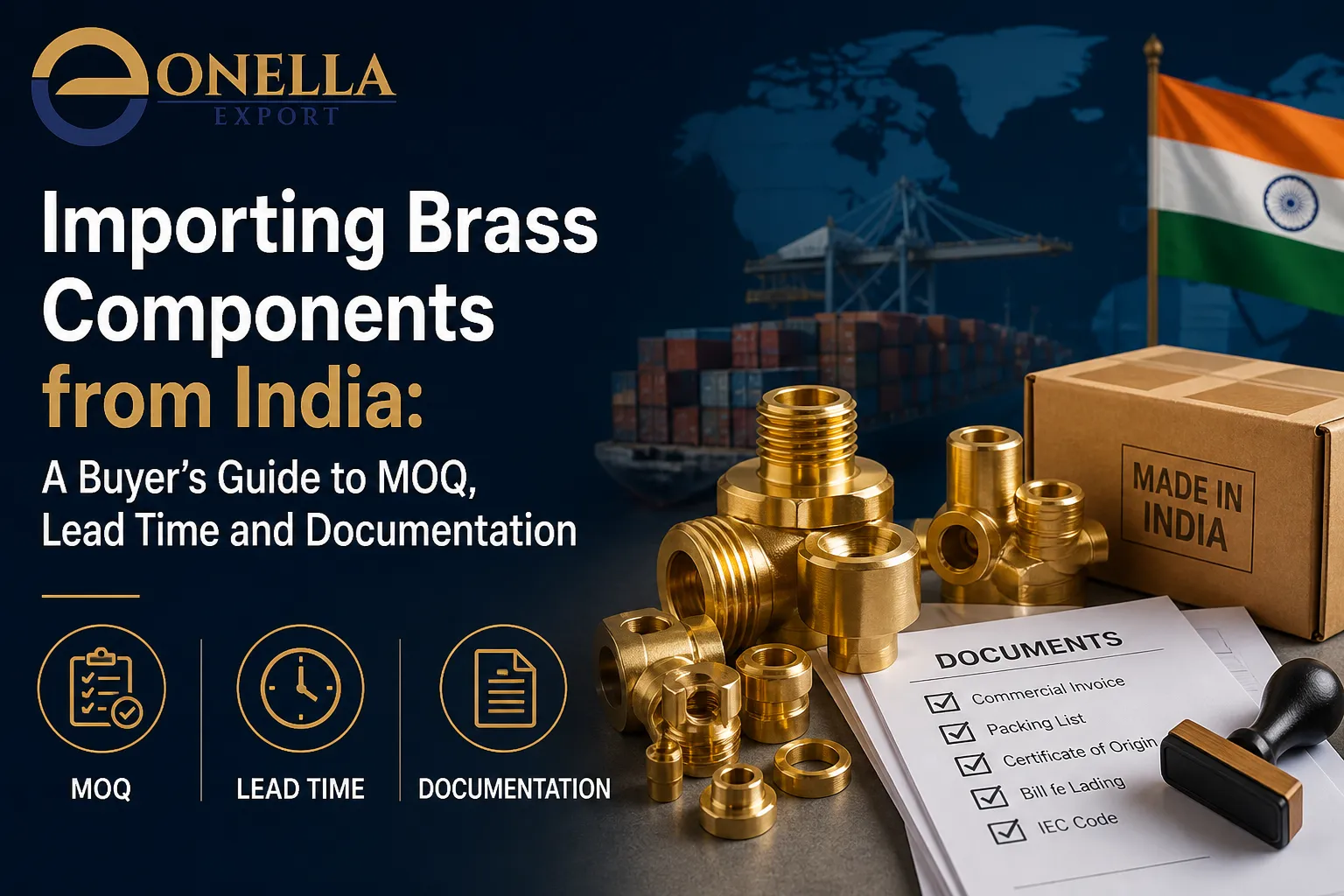
Sourcing brass components internationally comes with a learning curve that has little to do with the parts themselves and everything to do with process, minimum order quantities, realistic timelines, and the paperwork that determines whether your shipment clears customs without delay.
This guide walks new buyers through what to actually expect when working with a brass parts exporter India based, so the first order goes smoothly instead of becoming a crash course in import logistics.
Why Importing From India Appeals to Global Buyers
Cost is part of the story, but competitive pricing alone does not fully explain India's appeal. The country's established brass manufacturing hubs combine skilled machining labor with mature raw alloy supply chains. Crucially, experienced Indian manufacturers already understand complex export documentation, international quality standards, and customs compliance requirements.
For international procurement teams accustomed to non-conforming batches or logistical delays from less developed sourcing regions, established Indian exporters offer reliability. Working with a mature hub means fewer surprises once production begins, ensuring precise technical tolerances, predictable lead times, and seamless international delivery.
Understanding MOQ and Why It Varies by Component
Minimum order quantity is never a fixed number across the industry. Instead, MOQs fluctuate based on component complexity, required tooling setups, and whether a part is standard or custom. Standard brass fittings usually carry lower minimums because manufacturers run those production lines regularly. Conversely, custom-machined parts requiring specialized tooling configurations naturally demand higher order volumes to absorb initial setup costs efficiently.
When evaluating potential suppliers, avoid relying on broad, company-wide estimates. Always request an MOQ tailored strictly to your specific part drawings, material specifications, and machining requirements to ensure accurate budgeting and project planning.
Realistic Lead Times, From Inquiry to Shipment
A typical import timeline unfolds across several distinct stages, making realistic planning essential. Initial quotation and technical review usually take two to three business days following specification submission. Next, sample fabrication and dispatch require one to two weeks, depending on part complexity and machining tolerances.
Once samples are approved, full production lead time varies based on total order volume and specialized tooling requirements. Final transit time adds further duration, shifting significantly between ocean and air freight choices. Procurement teams that account for each stage and build in a realistic time buffer avoid the operational disruption that comes from underestimating total lead times.
Documentation You Should Expect From a Reliable Exporter
Material Test Certificates
Material Test Certificates confirm the exact alloy composition, chemical breakdown, and mechanical properties of the specific production batch you receive. These certificates provide verifiable proof that your components meet specified tensile strength, conductivity, and purity standards before installation.
Obtaining complete material documentation is essential for internal quality control verification, batch traceability, and fulfilling stringent regulatory requirements in high-consequence industries. A dependable exporter routinely provides these test reports alongside shipment dispatch, ensuring you possess full physical and technical accountability without needing to request missing quality compliance paperwork later.
Commercial Invoice and Packing List
The Commercial Invoice and Packing List serve as foundational international trade documents required for clear customs processing at both origin and destination ports. These papers detail exact itemized quantities, net and gross weights, harmonized tariff codes, unit values, and precise shipment contents.
An experienced exporter handles international trade requirements with accuracy and care, ensuring these documents match line items perfectly. Proper document preparation speeds up port clearance, prevents expensive customs delays or container storage fees, and eliminates the administrative frustration of buyers having to chase export partners for urgent clerical corrections.
Certificate of Origin
A Certificate of Origin officially verifies the country where your brass components were manufactured, acting as a critical instrument for international trade compliance. Importing authorities rely heavily on this document to determine appropriate import tariff rates, evaluate trade agreement benefits, and apply preferential duty treatments accurately.
A reliable, export-focused manufacturer treats the provision of an official Certificate of Origin as a standard operational procedure rather than an unexpected, special administrative request. Having this documentation ready upon shipment dispatch ensures your customs brokers can process incoming freight efficiently and maximize applicable tariff savings.
Questions to Ask Before Placing Your First Order
Before committing to a new supplier relationship, a short list of direct questions clarifies a lot:
- What's the MOQ for this specific component, not a general figure?
- What's the realistic lead time from sample approval to full shipment?
- Which documents are included by default, and which require a specific request?
- How do they handle a dimensional discrepancy discovered after the shipment arrives?
Clear, specific answers to these questions are a strong signal of a supplier who's handled export orders at scale before.
A Simple Framework for Evaluating New Suppliers
Evaluating a new manufacturing partner requires practical testing over verbal assurances. Start by placing a modest trial order below your full production volume. This initial run acts as a low-risk stress test, exposing their operational capabilities, quality control standards, and processing efficiency.
Pay close attention to how seamlessly they navigate the sample approval stage, how accurately they generate international trade documentation, and how transparently they communicate when adjustments are needed.
Manufacturers who deliver precision, adhere to schedules, and handle small initial orders with care demonstrate the reliability required for scaling into larger, long-term recurring orders.
Partner with a Trusted Indian Brass Manufacturer
Ready to streamline your import process with precision-engineered brass components? At Onella Export, we simplify global sourcing by delivering high-quality manufacturing, clear MOQ terms, transparent lead times, and hassle-free export documentation tailored to your exact specifications.
Contact Onella Export today to request a custom quote, arrange sample evaluations, or discuss your upcoming order requirements with our export specialists.
Frequently Asked Questions
Is MOQ negotiable for first-time buyers testing a new supplier?
Often yes, especially for standard catalog components. Custom parts requiring new tooling are less flexible, but it's always worth asking directly.
How far in advance should I place orders to avoid delays?
Building in a buffer beyond the quoted lead time, especially for first orders, helps absorb unexpected production or shipping delays without affecting your project schedule.
Can I request additional certifications beyond standard export documents?
Yes, most established exporters can provide additional certifications on request, though it's best to confirm availability and any added cost before finalizing your order.
Related articles
- How to Order Custom Brass Parts From a Drawing: What Your Supplier Needs From You
- Why Jamnagar Is India's Brass Parts Hub, and What That Means for Global Buyers
- How to Choose a Brass Ball Valve Manufacturer in India: 7 Checks Before You Order
- Brass vs Aluminium Stop Plugs: Which Is Right for Your Pipeline?
- All Onella Export articles