
-
Customer Mails & Inquiry
kp@onellaexport.com
-
Opening Times
08:00 AM - 08:00 PM
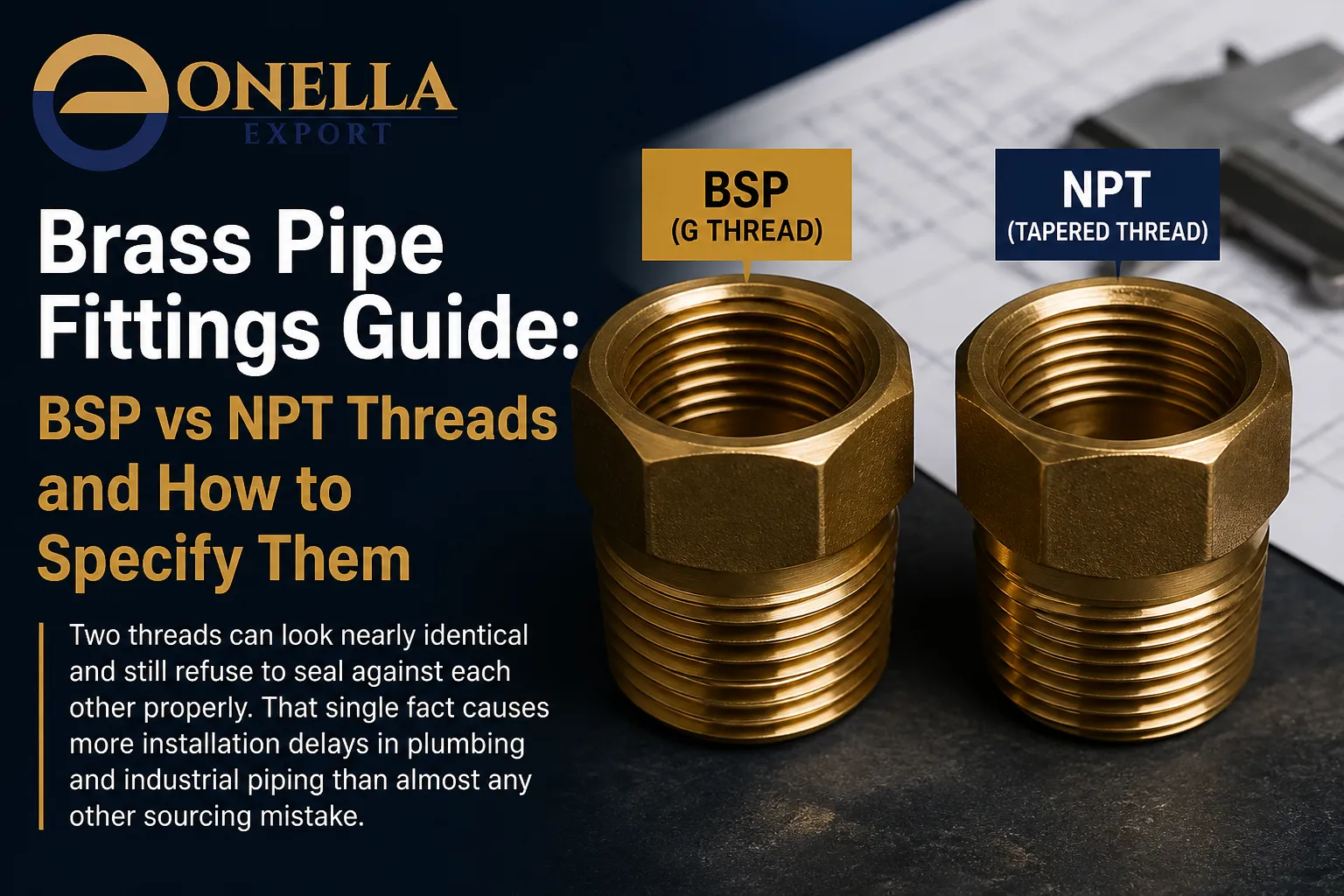
Two threads can look nearly identical and still refuse to seal against each other properly. That single fact causes more installation delays in plumbing and industrial piping than almost any other sourcing mistake.
This guide walks through the practical differences between BSP and NPT threads, and how to specify them correctly when ordering from a BSP brass fitting supplier, so your shipment fits the first time instead of sitting in a warehouse while someone sources adapters.
Understanding Thread Angle and Pitch Differences
The core operational difference between British Standard Pipe (BSP) and National Pipe Taper (NPT) lies in their geometric profiles. NPT threads feature a 60-degree thread angle with flattened crests and roots, designed primarily to form a pressure-tight seal through thread deformation. In contrast, BSP threads utilize a 55-degree Whitworth angle with rounded peaks and valleys.
Additionally, pitch measurements differ significantly; for instance, a 1/2-inch NPT fitting has 14 threads per inch (TPI), whereas a 1/2-inch BSP fitting features 14 TPI as well, but with vastly different flank angles that prevent interchangeable cross-threading without leaks.
Why Thread Standard Confusion Costs Buyers More Than They Realize
A mismatched thread doesn't always fail obviously. Sometimes it seats partially, holds for a while, then leaks under pressure weeks later.
Other times it simply won't thread on at all, and the entire shipment sits unused until replacement fittings arrive.
Either outcome costs time and money that a five-minute specification check at the ordering stage would have prevented entirely.
BSP Threads: Where They're Used and How They're Measured
British Standard Pipe thread is the dominant standard across most of the world outside North America, commonly used in plumbing, pneumatics, and general industrial piping.
BSP comes in two forms, parallel (BSPP) and tapered (BSPT), and the two aren't interchangeable despite looking similar. Measurement is based on nominal pipe size rather than actual outer diameter, which trips up buyers unfamiliar with the convention.
NPT Threads: Where They're Used and How They're Measured
National Pipe Thread is the standard most common in the United States and parts of North America. Unlike BSPP, NPT threads are always tapered, designed to create a seal through thread deformation as the fitting tightens.
Pitch and angle differ from BSP, which is exactly why a BSP fitting forced onto an NPT line, even when it initially threads on, won't create a reliable seal.
BSP vs NPT at a Glance
The differences come down to thread angle, pitch, and taper profile:
- BSP uses a 55-degree thread angle; NPT uses 60 degrees.
- BSPP is parallel and relies on a sealing washer or O-ring; BSPT and NPT are both tapered and sealed through thread engagement.
- Regional usage differs significantly, BSP across Europe, Asia, and Australia; NPT primarily in North America.
Even a one-degree difference in thread angle is enough to prevent a proper seal, which is why visual similarity is a poor substitute for actual verification.
How Different Thread Types Achieve a Leak-Proof Seal
Choosing the correct thread profile directly dictates how your piping assembly must be sealed. Tapered variants, such as NPT and BSPT, rely on metal-to-metal contact along the tapered flanks to establish a seal, typically requiring thread sealant tape or liquid pipe dope to fill micro-gaps.
Conversely, parallel threads like BSPP do not create a seal along the thread engagement itself. Instead, BSPP relies on an auxiliary elastomeric O-ring, bonded washer, or flush seating face to block fluid passage. Using thread tape on parallel threads often causes misaligned seating and leads to persistent pressure leaks.
How to Specify the Right Thread When Ordering
The safest approach is to specify the exact standard, BSPP, BSPT, or NPT, in writing on every purchase order, not just "standard thread" or a size alone.
If you're replacing existing fittings, send a sample or the thread gauge measurements rather than assuming the new supplier will match what you had previously.
A reliable brass pipe fittings exporter India based or otherwise should confirm the standard back to you before production, not after the shipment arrives.
Common Mistakes Buyers Make With Thread Specification
Assuming Visual Similarity Means Compatibility
BSP and NPT fittings can look nearly identical in photos or even in hand. The only reliable way to confirm compatibility is thread gauge measurement, not a visual comparison.
Not Specifying Parallel vs Tapered BSP
Ordering "BSP" without clarifying BSPP or BSPT leaves room for a supplier to default to whichever they stock more of, which may not match your sealing requirement.
Skipping a Physical Sample Check
Even with correct paperwork, a physical sample test-fit before bulk production catches errors that specification sheets sometimes miss, particularly on older or non-standard installations.
Why Brass Grade Selection Matters in Thread Machining
While thread standards determine mechanical compatibility, the brass alloy composition dictates structural longevity under high torque and exposure.
Free-machining brass alloys, such as CW614N or C36000, are favored for high-precision CNC thread cutting due to their excellent chip formation and tight tolerance control. However, applications exposed to corrosive fluids or brackish environments require dezincification-resistant (DZR) brass alloys like CW602N.
Specifying thread standards without indicating the appropriate brass grade can lead to stress corrosion cracking or premature thread stripping under pressure, rendering even accurately machined thread profiles completely ineffective in the field.
Working With a Supplier Who Gets This Right
A supplier who asks clarifying questions about your thread standard before quoting is doing exactly what they should. One who quotes immediately without asking is either very confident or not paying close enough attention.
For buyers importing in bulk, confirming thread standard isn't a minor detail, it's the difference between a shipment that installs cleanly and one that sits in a warehouse awaiting correction.
Ready to order bulk brass fittings with precision-matched thread standards? Contact Onella Export today to get custom specifications, high-grade alloys, and zero-defect global delivery.
Frequently Asked Questions
Can BSP and NPT fittings be connected using an adapter?
Yes, thread adapters exist for this exact purpose, though they add a connection point and potential leak risk, so matching thread standards directly is usually preferable.
Is BSPP or BSPT more common for general plumbing applications?
Both are used depending on application and region, but BSPT is more common where thread sealing without an additional washer or O-ring is required.
Should I request a sample before placing a bulk fitting order?
Yes, especially when replacing existing stock. A physical sample test-fit confirms compatibility before committing to a full production run and shipment.
Related articles
- Importing Brass Components from India: A Buyer's Guide to MOQ, Lead Time and Documentation
- How to Order Custom Brass Parts From a Drawing: What Your Supplier Needs From You
- Why Jamnagar Is India's Brass Parts Hub, and What That Means for Global Buyers
- How to Choose a Brass Ball Valve Manufacturer in India: 7 Checks Before You Order
- All Onella Export articles