
-
Customer Mails & Inquiry
kp@onellaexport.com
-
Opening Times
08:00 AM - 08:00 PM
Published by Onella Export on 20 October 2026
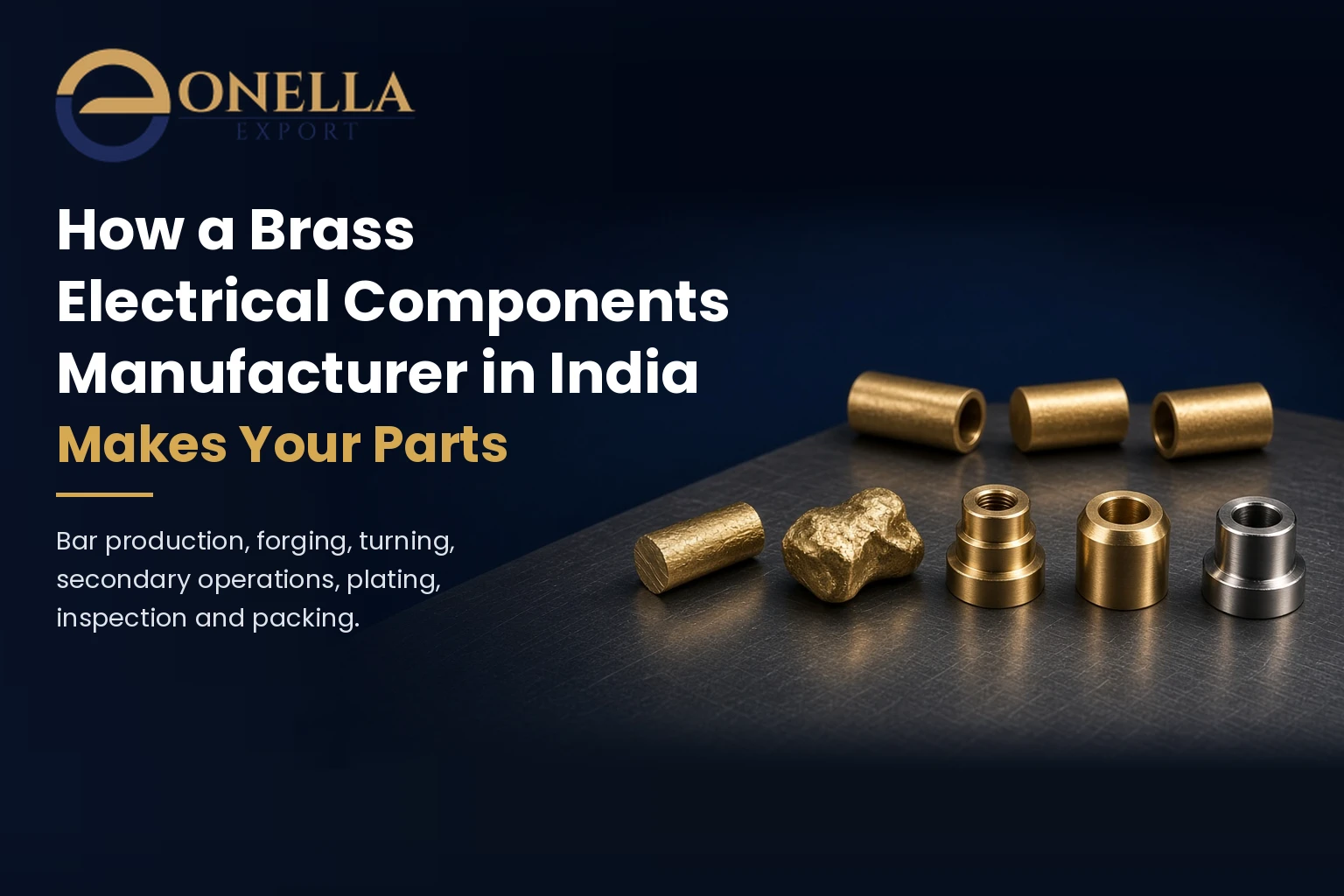
Buyers often judge a brass parts supplier by its samples and price. But consistent quality over thousands or millions of parts depends on what happens behind the samples: where the brass comes from, how it is machined, how it is finished and how it is checked. Knowing the process helps you ask better questions and spot risks early.
This article follows a typical brass electrical part through production at an integrated brass electrical components manufacturer in India. To see why so many of these manufacturers are in Gujarat, read why Jamnagar is India's brass parts hub.
Step 1: Brass Bar Production
Production starts with the raw material. Brass is melted and cast, then formed into solid and hollow bars of the required diameter. Onella Export runs its own foundry, producing around 5,000 kg of brass solid and hollow bars a day. Making bars in-house gives control over alloy composition and bar quality, which directly affects machinability and conductivity.
Step 2: Forging for Complex Shapes
Some parts, such as bodies with irregular shapes, are hot forged before machining. Forging produces a dense structure and near-final shape, reducing machining time and material waste.
Step 3: Turning
Most electrical parts are turned from bar on multi-spindle automatic lathes and CNC turning machines. Multi-spindle machines suit high volumes of simple parts, while CNC machines handle complex shapes and shorter runs with quick changeovers. Threads, bores, grooves and profiles are cut in this stage.
Step 4: Secondary Operations
- Cross-drilling and tapping for terminal screws
- Milling of flats and slots
- Knurling for grip in moulded plastic
- Cutting to length and chamfering
Step 5: Deburring and Cleaning
Burrs can damage insulation, interfere with assembly or cause poor contact. Parts are deburred, often by tumbling, then cleaned to remove cutting oil before finishing.
Step 6: Plating and Finishing
Depending on the specification, parts receive tin, nickel or silver plating, or passivation. Plating thickness and adhesion are checked, because they affect conductivity, corrosion resistance and thread fit.
Step 7: Inspection
| Check | Tool or method |
|---|---|
| Thread accuracy | Go/no-go thread gauges |
| Critical dimensions | Vernier, micrometer and optical comparator |
| Visual defects | Inspection for burrs, cracks and plating defects |
| Material | Composition testing and material test certificates |
Read about Onella's quality approach.
Step 8: Packing
Parts are counted, bagged and boxed with labels showing part number, quantity and batch. Export packing protects parts from moisture and tarnish during sea freight. See importing brass components from India.
Why an Integrated Manufacturer Matters
When bar production, forging, turning and finishing sit under one roof, problems are traced and fixed faster.
- Material control: in-house bar production keeps alloy quality consistent.
- Accountability: one company owns quality from melting to dispatch.
- Speed: fewer hand-offs between subcontractors shorten lead times.
- Cost: fewer middlemen and less transport between processes.
Questions to Ask a Manufacturer
Use these questions during your first call or factory visit:
- Do you make brass bars in-house or buy them?
- Which steps, such as forging, turning, plating, are done in-house?
- How do you inspect threads and critical dimensions?
- Can you provide material test certificates?
- How quickly can you quote and sample? Onella aims to quote within 24 hours of receiving drawings.
About Onella Export
Onella Export has manufactured and exported brass components from Jamnagar, Gujarat since 1991. It is an ISO 9001:2015 certified manufacturer with its own foundry producing around 5,000 kg of brass solid and hollow bars a day, plus in-house forging and machine turning. Customers are spread across India, the Middle East, the Far East, Europe and America.
Related Reading
- Why Jamnagar is India's brass parts hub
- CNC brass turned parts: how to specify and source
- Brass electrical and electronic components: types and applications
Frequently Asked Questions
How are brass electrical components manufactured?
Brass is cast and formed into bars, sometimes forged, then turned on automatic or CNC lathes. Parts go through drilling, tapping and other secondary operations, are deburred, cleaned, plated if required, inspected and packed.
Why does in-house brass bar production matter?
It gives the manufacturer control over alloy composition and bar quality, which affects machinability, conductivity and consistency.
What machines are used to make brass electrical parts?
Multi-spindle automatic lathes for high volumes of simpler parts and CNC turning machines for complex shapes and shorter runs, plus drilling, tapping and milling equipment.
How are brass electrical parts inspected?
With thread gauges, measuring instruments such as micrometers and optical comparators, visual checks and material testing.
How fast can Onella Export quote for custom parts?
Onella aims to issue an itemised quotation within 24 hours of receiving drawings and quantities.
Get a Quote From a Jamnagar Manufacturer
Contact Onella Export with your drawing, sample or specification, email kp@onellaexport.com or call +91 97276 77787.