
-
Customer Mails & Inquiry
kp@onellaexport.com
-
Opening Times
08:00 AM - 08:00 PM
Published by Onella Export on 23 October 2026
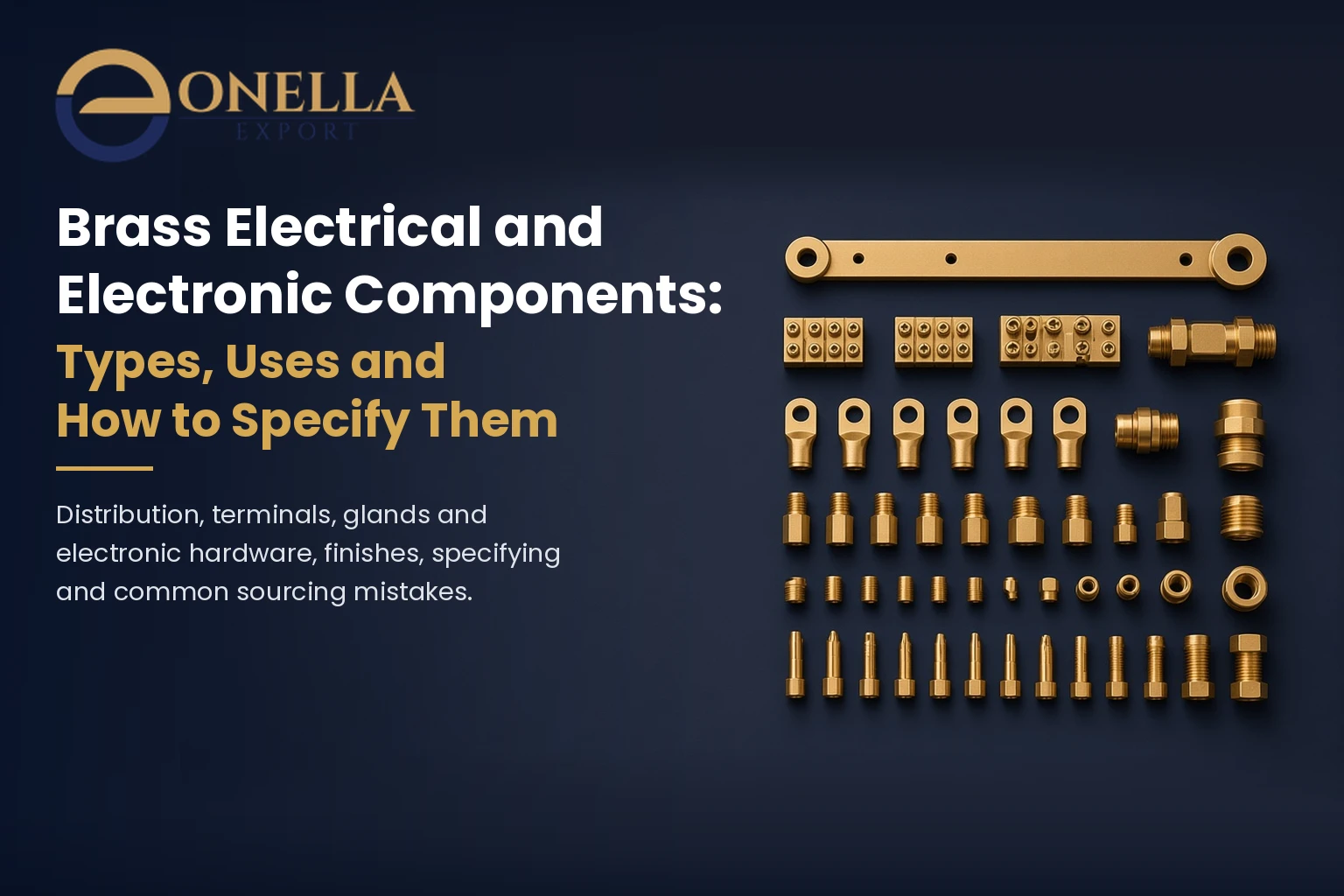
Open almost any electrical panel, meter, switch or electronic device and you will find small brass parts doing critical work: carrying current, clamping wires, grounding metalwork or holding circuit boards in place. Brass is used because it conducts well, machines accurately, resists corrosion and is strong enough to hold threads under torque.
This guide groups the main brass electrical and electronic components by function, explains where each is used and shows how to specify them clearly. For the reasons brass suits electrical work, read why brass is the preferred metal for electrical components.
1. Distribution and Grounding Components
| Component | Function | Typical use |
|---|---|---|
| Neutral bars and links | Common connection point for neutral conductors | Distribution boards, consumer units, panels |
| Earth terminals and bars | Connect protective earth conductors | Panels, enclosures, equipment frames |
| Grounding blocks | Join several earth conductors securely | Industrial panels, telecom, solar |
| Busbar connectors | Connect busbars and cables | Switchgear and power distribution |
See our dedicated guide to brass neutral links.
2. Terminals and Connectors
Screw terminals, pillar terminals, terminal block parts, cable connectors and meter terminals clamp conductors and carry current between them. Read more in our guide to brass terminal connectors.
3. Cable Glands and Adaptors
Cable glands, locknuts, stop plugs and thread adaptors secure cables where they enter enclosures, relieve strain and seal out dust and water. See what to check before ordering cable glands in bulk.
4. Electronic Hardware
- PCB standoffs and spacer pillars: hold circuit boards at a fixed height and provide grounding paths.
- Meter socket terminals: connect meters to supply and load conductors.
- Switch contacts: carry current when a switch closes.
- Inserts: threaded moulding inserts that give plastic housings durable screw threads. Learn how moulding inserts improve mould life and cycle time.
Finishes for Electrical Use
| Finish | Benefit |
|---|---|
| Natural brass | Economical for enclosed, dry environments |
| Tin plating | Good solderability and stable contact surfaces |
| Nickel plating | Corrosion resistance and a clean appearance |
| Silver plating | Very low contact resistance for demanding contacts |
| Passivation | Slows tarnishing of bare brass |
Choose finishes based on the installation environment, such as humidity, chemicals and temperature. For outdoor, coastal or industrial sites, plated parts usually last longer than bare brass, while enclosed indoor equipment can often use natural brass to save cost.
How to Specify Brass Electrical Components
- Provide a drawing or sample with critical dimensions and tolerances.
- State the thread type and size for every tapped or threaded feature.
- Name the brass grade if your product standard requires one.
- Specify plating type and thickness, and whether dimensions apply before or after plating.
- Give quantities, annual volume and packing requirements.
For custom parts, read how to order custom brass parts from a drawing and how to specify CNC brass turned parts.
Common Sourcing Mistakes
- Sending drawings without thread details, which leads to parts that do not fit standard screws.
- Approving samples on appearance alone without testing them in the actual assembly.
- Ordering bare brass for humid environments where plating is needed.
- Splitting related parts across many suppliers, which makes finishes and quality inconsistent.
Who Buys These Components
- Switchgear and panel builders
- Meter and wiring accessory manufacturers
- Electronics and appliance OEMs
- Solar and telecom equipment makers
- Distributors of electrical hardware
About Onella Export
Onella Export has manufactured and exported brass components from Jamnagar, Gujarat since 1991. It is an ISO 9001:2015 certified manufacturer with its own foundry producing around 5,000 kg of brass solid and hollow bars a day, plus in-house forging and machine turning. Customers are spread across India, the Middle East, the Far East, Europe and America.
Related Reading
- Why brass is the preferred metal for electrical components
- Brass terminal connectors: types, specs and export packing
- Brass neutral links: types, specifications and ordering
Frequently Asked Questions
What are brass electrical and electronic components?
They are brass parts used in electrical and electronic products, such as neutral and earth bars, terminals, connectors, cable glands, PCB standoffs, meter terminals, switch contacts and threaded inserts.
Why is brass used for electrical components?
Brass conducts electricity well, machines accurately, resists corrosion and holds threads under torque, which makes it suitable for terminals, connectors and grounding parts.
Which plating is best for brass electrical parts?
It depends on the environment and function. Tin aids solderability, nickel improves corrosion resistance, silver gives very low contact resistance and passivation slows tarnishing.
Can brass electronic hardware be made to my drawing?
Yes. Onella Export machines brass components to customer drawings, blueprints or physical samples.
What information do I need to request a quote?
Send a drawing or sample, thread details, material grade, plating requirements, quantities, annual volume and packing needs.
Request Brass Electrical Component Quotes
Contact Onella Export with your drawing, sample or specification, email kp@onellaexport.com or call +91 97276 77787.