
-
Customer Mails & Inquiry
kp@onellaexport.com
-
Opening Times
08:00 AM - 08:00 PM
Published by Onella Export on 2 October 2026
Terminal connectors are where wires meet devices. In switches, sockets, distribution boards, meters and terminal blocks, small brass terminals clamp conductors and carry current every day for years. A loose thread, a poor clamping face or tarnished contact surface can cause overheating and failure, so buyers need consistent parts, delivered in the same condition they left the factory.
This guide covers the main types of brass terminal connectors, the specifications to agree and what to expect from a brass terminal connector exporter.
Common Types of Brass Terminal Connectors
| Type | Description | Typical use |
|---|---|---|
| Screw terminals | Threaded body with a clamping screw | Switches, sockets, wiring accessories |
| Pillar terminals | Cylindrical body with a side-entry screw | Plugs, sockets, fuse carriers |
| Terminal block parts | Clamps and bodies inside terminal blocks | Panels and control wiring |
| Cable connectors | Join two or more conductors | Distribution wiring |
| Meter terminals | Connect supply and load to meters | Energy meters and meter sockets |
| Earth terminals | Connect protective earth conductors | Enclosures and equipment |
Specifications to Agree
- Dimensions and tolerances: especially the conductor hole, thread and clamping face.
- Thread type and size: metric or other standards, matched to your screws.
- Material grade: name it if your product standard requires a specific brass.
- Plating: tin, nickel or silver, with thickness.
- Screws: whether screws are supplied fitted, loose or not at all.
- Electrical requirements: current rating depends on your product design and standard; share it so the supplier understands critical features.
For design and drawing tips, read how to order custom brass parts from a drawing.
Samples and First Article Approval
- Approve dimensions and threads on samples against your drawing.
- Test the terminal in your product, including screw torque and conductor clamping.
- Approve the plating finish in writing.
- Keep approved samples to compare with future lots.
Export Packing That Prevents Tarnish
Brass can tarnish in humid conditions, especially during long sea voyages through hot climates. Good exporters protect parts with:
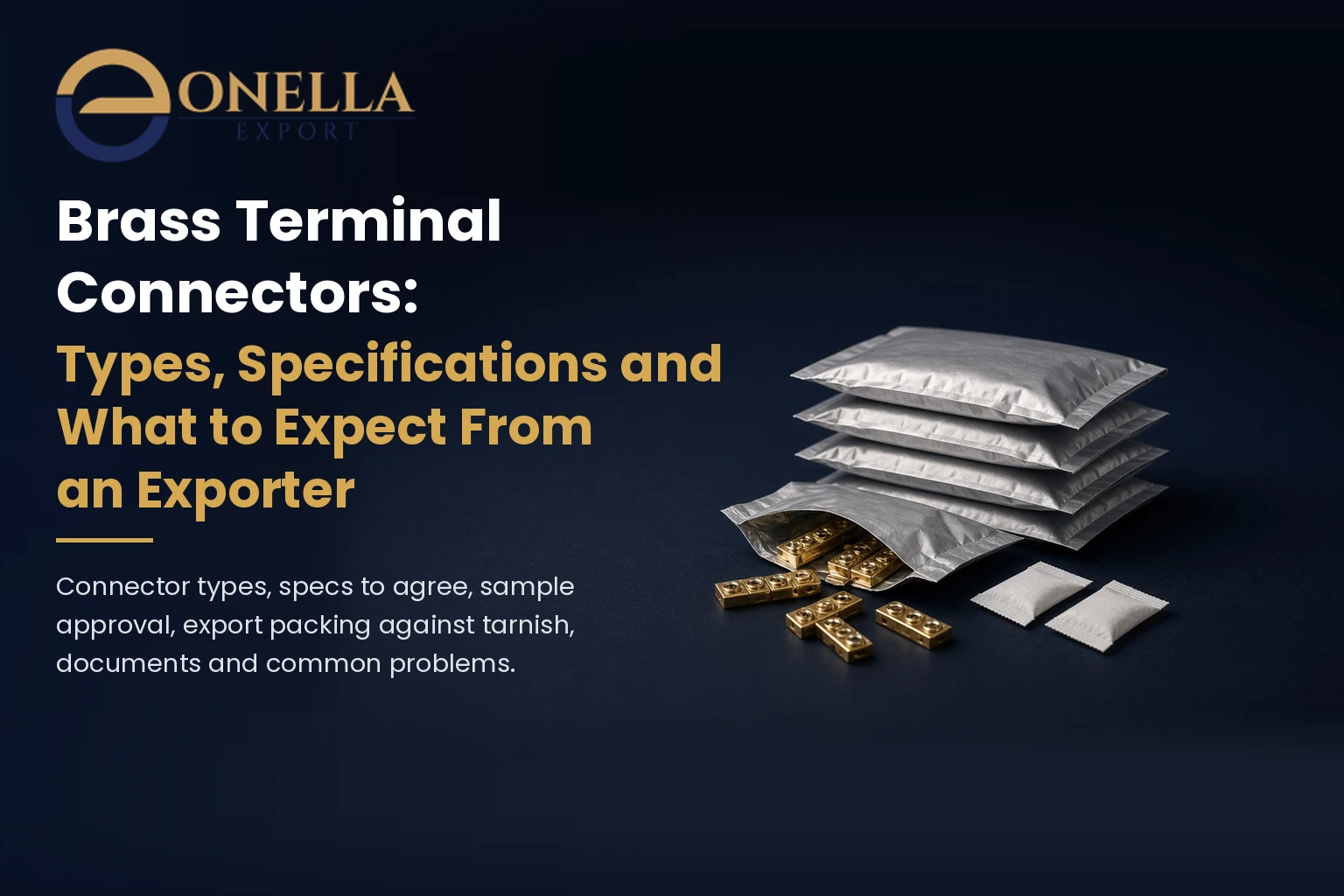
- Sealed polythene bags, often with anti-tarnish or VCI protection
- Desiccants where required
- Strong cartons with counted quantities and clear labels
- Palletised or well-stacked loads to avoid crushed cartons
Agree packing in advance, especially for bare or lightly finished brass. Ask for photographs of packed cartons before dispatch on your first few orders, so you can confirm that labelling and protection match your requirements.
Documents You Should Receive
- Commercial invoice and packing list with part numbers and quantities
- Certificate of origin
- Bill of lading or air waybill
- Material test certificate where required
- Inspection report if agreed
See our guide to MOQ, lead time and documentation.
Common Problems and How to Prevent Them
| Problem | Prevention |
|---|---|
| Stripped threads during assembly | Agree thread tolerances and test with your screws and torque |
| Tarnish on arrival | Specify plating or anti-tarnish packing |
| Burrs damaging conductors | Specify deburring and inspect samples |
| Mixed parts in cartons | Require part-number labels and fixed packing quantities |
Choosing a Brass Terminal Connector Exporter
- Integrated production from brass bar to finished part
- Multi-spindle and CNC turning for both volume and complexity
- In-house checks with thread gauges and optical comparators
- Experience with export documentation and packing
- Fast, clear communication on drawings and samples
Onella Export supplies terminal connectors alongside neutral links, earth terminals, cable glands and electronic hardware.
About Onella Export
Onella Export has manufactured and exported brass components from Jamnagar, Gujarat since 1991. It is an ISO 9001:2015 certified manufacturer with its own foundry producing around 5,000 kg of brass solid and hollow bars a day, plus in-house forging and machine turning. Customers are spread across India, the Middle East, the Far East, Europe and America.
Related Reading
- Brass neutral links: types, specifications and ordering
- Importing brass components from India: MOQ, lead time and documentation
- Brass electrical and electronic components: types and applications
Frequently Asked Questions
What types of brass terminal connectors are there?
Common types include screw terminals, pillar terminals, terminal block parts, cable connectors, meter terminals and earth terminals.
What should I specify when ordering brass terminals?
Specify dimensions and tolerances, conductor hole size, thread type and size, material grade, plating type and thickness, whether screws are included, and quantities.
How do exporters stop brass terminals tarnishing during shipping?
By packing parts in sealed polythene bags, often with anti-tarnish or VCI protection and desiccants, inside strong, clearly labelled cartons.
Which documents come with an export order of brass terminals?
Typically a commercial invoice, packing list, certificate of origin, bill of lading or air waybill, and material test certificates or inspection reports where agreed.
Can brass terminals be made to my drawing?
Yes. Onella Export manufactures terminal connectors to customer drawings, blueprints or samples.
Request Terminal Connector Samples
Contact Onella Export with your drawing, sample or specification, email kp@onellaexport.com or call +91 97276 77787.