
-
Customer Mails & Inquiry
kp@onellaexport.com
-
Opening Times
08:00 AM - 08:00 PM
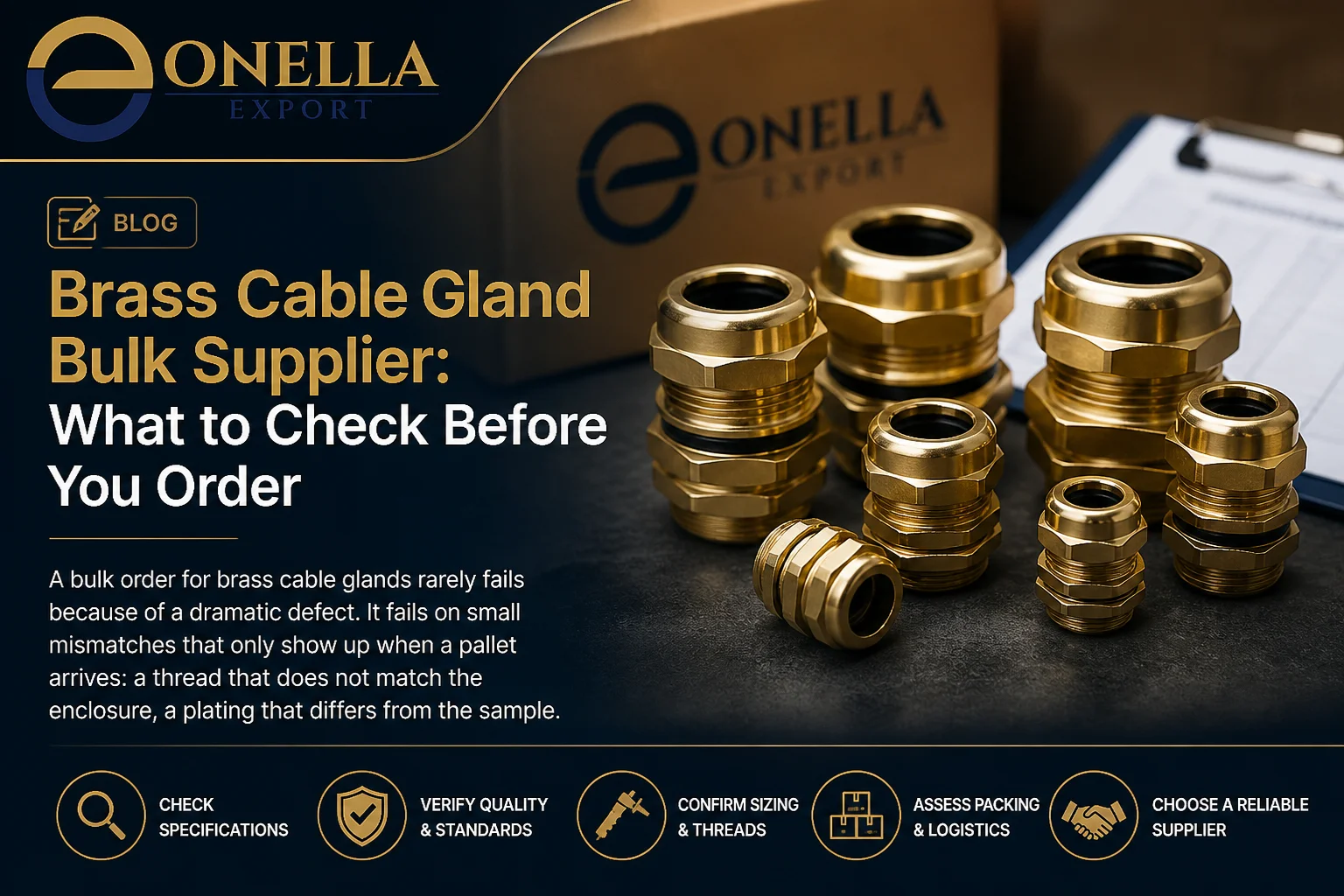
A bulk order for brass cable glands rarely fails because of a dramatic defect. It fails on small mismatches that only show up when a pallet arrives: a thread that does not match the enclosure, a plating that differs from the sample, a carton count that does not match the packing list. Each is cheap to prevent before you order and expensive to fix afterwards.
This checklist is for buyers comparing a brass cable gland bulk supplier. It covers what to specify, what to ask, and what to expect on documents, drawing on guidance Onella Export has already published on its own site for brass buyers.
Steps to Follow Before Ordering from Brass Cable Gland Bulk Supplier
Write the Specification First
Suppliers can only quote accurately against a clear brief. Before you send an enquiry, write down:
- Thread type and size for the gland entry
- Cable range the gland must accommodate
- Material grade, if your project names one
- Plating or finish
- Quantity for the first order and expected annual volume
- Any drawing or sample you want matched
Onella’s guide on ordering custom brass parts from a drawing explains what a manufacturer needs in order to quote, including dimensions, tolerances, material, finish and thread specifications. Use it as a template for your own request.
If you have an existing gland that works, send a sample as well as the drawing. A sample resolves ambiguities that a drawing can leave open.
Confirm the Thread Standard in Writing
Onella’s published advice for brass buyers is blunt on this point: BSP, NPT and metric threads are not interchangeable, and a mismatch means adapters, delays or a part that does not fit. Its ball valve guide recommends confirming in writing which standard the manufacturer machines to and whether it matches your existing system exactly.
Apply the same discipline to cable glands. Name the thread standard and size on the purchase order, not only in an email thread, and ask the supplier to confirm it back. The article on BSP vs NPT threads in brass pipe fittings explains how those standards are specified and the mistakes to avoid.
Ask About Material and Alloy Grade
Onella’s article on brass in electrical components advises asking which alloy grade a supplier works with, and being cautious if a supplier cannot name one. It also suggests asking why that grade suits your application, not accepting a generic answer.
For a bulk order, ask:
- Which alloy grade will the glands be made from?
- Is the grade the same across the whole order, and will it stay the same on repeat orders?
- Can the supplier provide a material test certificate for the batch?
Onella’s brass sanitary components page names grades such as CuZn40Pb2 and CuZn39Pb3 for that product line, which shows the kind of specific answer you should expect from a supplier. Gland material should be confirmed with the supplier for your own enquiry.
Plating and Finish
Onella’s electrical components article notes that tin, nickel and silver plating serve different purposes in terms of surface conductivity, contact resistance and oxidation prevention, and recommends asking a manufacturer to propose a surface treatment based on the actual installation environment.
Give your supplier that environment. Say whether the glands will sit indoors or outdoors, in a humid area, near chemicals or in a dry control room. Then ask:
- Which finishes can you supply for this part?
- Can you send a finished sample, not a photograph?
- How is finish consistency controlled from one production lot to the next?
Approve a finished sample in writing before bulk production starts. If you will reorder, keep the approved sample so later lots can be compared with it.
Sizes, Tolerances and Fit
A gland has to fit the enclosure on one side and the cable on the other, so check both. Mark the dimensions that matter most on your drawing, such as thread, entry and the point where the sealing parts seat. Ask how the supplier measures them and how often.
Onella states that it has its own forging and machine turning facilities in-house, along with a foundry producing brass solid and hollow bars. When you evaluate any supplier, ask the same question: which steps happen under one roof, and which are subcontracted? The answer tells you who is responsible if a dimension drifts.
Packing for Bulk Shipments
Bulk shipments travel further and experience significantly more handling than sample parcels, making clear packing agreements essential.
Prior to dispatch, confirm how glands are arranged within each carton, the exact quantity per box, and whether loose components like nuts and seals are packaged together or separately. Clear outer labeling featuring part numbers and batch quantities simplifies inventory checks upon arrival.
You should also confirm specific protective measures for sea or air freight to prevent damage during transit, and request a copy of the packing list format early so your receiving team can prepare for smooth verification.
Export Documentation
When working with a trusted brass electrical components manufacturer India, clear documentation ensures smooth customs clearance and quality verification. Standard export paperwork typically includes material test certificates, commercial invoices, detailed packing lists, and certificates of origin.
Initial quotation and technical review usually take two to three business days, while sample fabrication and dispatch require one to two weeks depending on component complexity.
Confirm upfront which documents are provided by default, which require special requests, and how the supplier handles potential dimensional discrepancies after shipment arrival.
MOQ and Trial Orders
Onella’s importing guide explains that minimum order quantity varies with component complexity, tooling and whether the part is standard or custom, and advises requesting an MOQ for your specific drawing instead of relying on a general figure. It also recommends a modest trial order before full volume, as a low-risk test of a supplier’s quality control, document accuracy and communication.
Follow that advice. A trial order shows how a supplier handles sample approval, how accurate its documents are, and how it communicates when something needs adjusting.
Supplier Checks Before You Commit
Before placing an order, evaluate the manufacturer beyond the product specifications. Start by verifying raw material sources, confirming whether machining is completed in-house, and requesting valid ISO certificates to back up any quality claims. Sending a direct technical query helps gauge the supplier's responsiveness and industry expertise.
For instance, Onella Export operates as an ISO 9001:2015 certified manufacturer in Jamnagar, Gujarat, with decades of production experience. Requesting official certification documents and discussing technical requirements upfront ensures you partner with a dependable supplier capable of delivering consistent quality.
To discuss a bulk requirement, send your specification, drawing or sample by contacting Onella Export.
FAQs
What should I include in a bulk enquiry for brass cable glands?
Include thread type and size, cable range, material grade, plating, order quantity, annual volume and any drawing or sample.
How do I avoid thread mismatches?
Name the thread standard and size on the purchase order and ask the supplier to confirm it in writing. BSP, NPT and metric threads are not interchangeable.
Should I place a trial order first?
A modest trial order is a low-risk way to test quality control, documentation and communication before committing to full volume.
Related articles