
-
Customer Mails & Inquiry
kp@onellaexport.com
-
Opening Times
08:00 AM - 08:00 PM
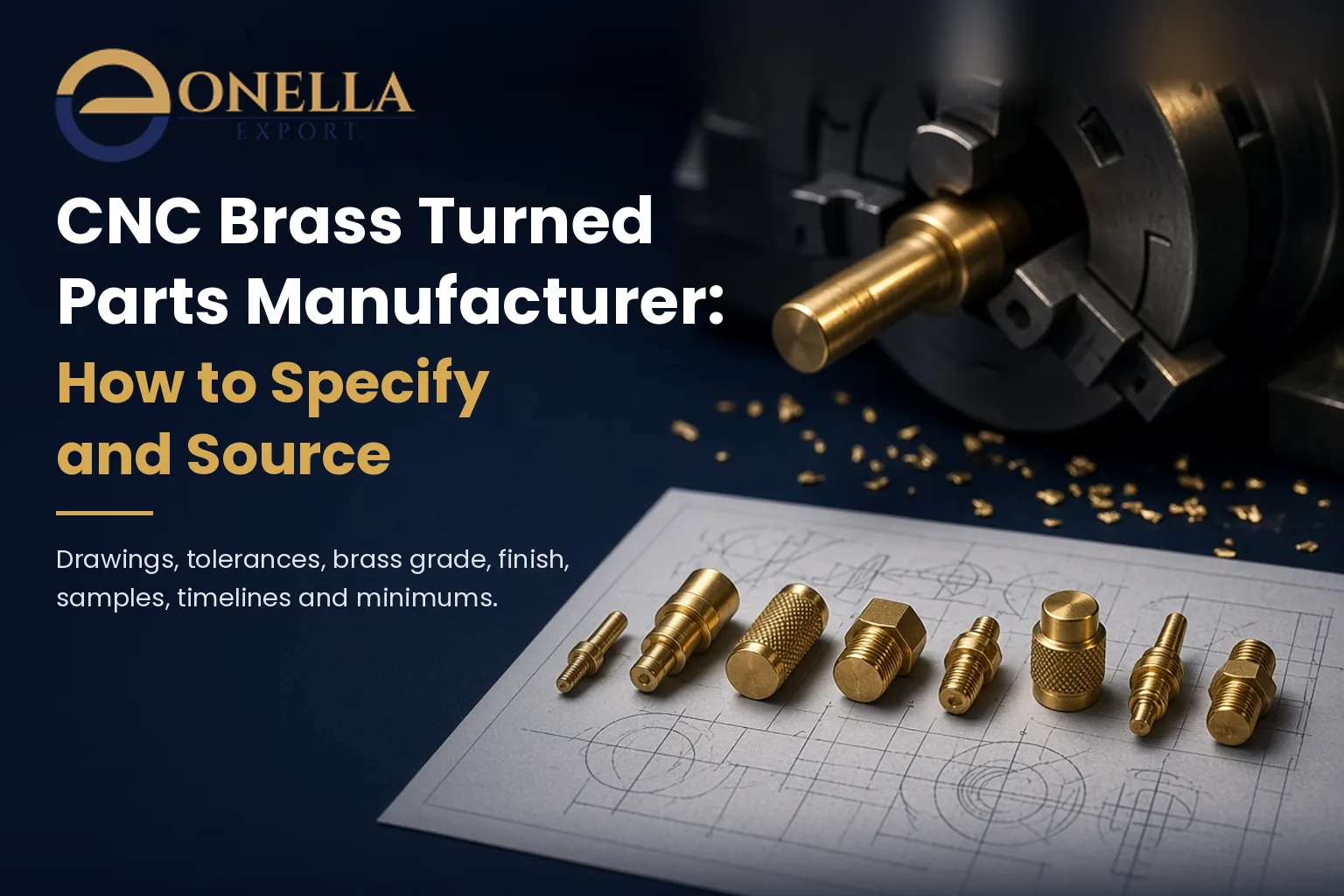
A turned brass component can look remarkably simple on a technical drawing, yet still fail in production in a dozen small ways: a thread that fails to mate, a bore that sits slightly off-center, or an entire production batch that slowly drifts from the approved sample. Most of these quality issues begin with the initial brief, not the machinery itself.
If you are searching for a CNC brass turned parts manufacturer, the accuracy of what you send directly determines the quality of what comes back. Taking time to specify exact tolerances, material grades, and surface finishes prevents costly rework down the line.
Here is how to prepare a thorough enquiry, what critical questions to ask vendors in return, and where buyers tend to lose valuable time during procurement.
What Belongs in the Drawing Package
Send a dimensioned drawing, ideally a CAD file alongside a PDF, so nothing is lost in conversion. Mark the dimensions that really matter: mating diameters, thread details, critical lengths. Then add the quantity, whether it’s a one-off or a repeating requirement, and what the part actually does.
That last detail gets forgotten, yet it changes the conversation. A part that sits inside a plumbing fitting has different needs from one that’s purely decorative, and a manufacturer who knows the use can raise issues you hadn’t thought of. If you want brass parts as per drawing, a complete package is what lets the maker quote accurately the first time instead of sending questions back and forth for a week.
Tolerances: Be Strict Where It Counts
Every extra decimal place adds machining care and usually adds cost. Asking for tight tolerances everywhere is a common and expensive habit. Asking for none is the opposite mistake, because the supplier will then fill the gap with their own assumptions.
Pick the features that must be precise, such as a mating surface that aligns with another component or a thread that has to seat properly. Call those out clearly, and leave general dimensions on a standard tolerance. Then ask how the critical dimensions are measured and how often during a run. A measurement that happens once at the start tells you less than one repeated through the batch.
Choosing the Brass Grade
Brass isn’t a single material. Different grades machine differently, take finishes differently and behave differently in service. Free-cutting grades, for example, are widely used for turned components because they cut cleanly, though that isn’t the right choice for every application.
If you already need a specific grade, state it in the enquiry and ask for written confirmation. If you don’t, describe the part’s job (carries pressure, holds a thread, stays on show) and ask what the supplier recommends and why. Be wary of a reply that skips the reasoning, or of any substitution you hear about only after the parts arrive.
Finish and Surface Expectations
Decide early whether you want the part as machined or with a further finish, and say so up front. Ask whether any finishing happens in-house or with a partner, and request a sample on your own part rather than a generic photo.
Also settle how finished parts are packed. Loose brass pieces knocking together in a carton can arrive with marks that nobody planned.
Samples Before Volume
A sample is the cheapest insurance you can buy. Hold it, fit it against its mating part and check it against the drawing. If something is wrong, you’ve lost a few days, not a pallet.
Agree beforehand what the sample is meant to prove. Is it checking dimensions, thread fit, surface or all three? And keep it. When production arrives, comparing against an approved sample settles arguments faster than comparing against memory.
Managing Timelines and Production Milestones
Planning the Initial Prototyping Schedule
Allow adequate days for initial sample fabrication and shipping before setting hard launch dates.
Tracking Batch Production Milestones
Request clear weekly status updates from your vendor to catch any unexpected delays early.
Factoring in Transit and Logistics
Account for customs clearance times and international freight shipping when mapping your delivery windows.
Scheduling Final Quality Sign-Offs
Build dedicated inspection buffers into your calendar before approving full-scale production runs.
Talking About Minimums
Minimum quantities vary, and they depend on the part, the material and the setup involved. Instead of guessing, ask directly what the minimum is for your component and why. If you’re testing a new design, say so, and ask whether a smaller trial lot is possible. A supplier who explains the reasoning behind a minimum is easier to work with than one who simply names a number.
Think about repeats too. If the part will be reordered, ask how drawings and approved samples are kept on file so the second batch matches the first.
Why Jamnagar Keeps Coming Up
Jamnagar has long been associated with brass component making in India, and many buyers start their search there. Searching for a brass components manufacturer Jamnagar buyers recommend is a fair first step, but location alone proves nothing.
Ask the same questions of every supplier wherever they are: how they check dimensions, how they confirm material and how they handle a batch that falls outside tolerance.
A Short Pre-Send Checklist
- Drawing in CAD and PDF, with critical dimensions marked
- Material or grade stated, or the part’s job described
- Finish requirement, if any
- Quantity, repeat expectation and target date
- A request for a sample before volume
Send Your Drawing to Onella Export
Have a drawing ready? Share it with the Onella Export team through the contact page, along with your material, finish and quantity needs.
FAQs
What file formats should I send to a brass turned parts manufacturer?
A PDF drawing plus a CAD file is ideal. Mark critical dimensions and tolerances so the quote reflects what matters.
Do all dimensions need tight tolerances?
No. Reserve tight limits for mating features and critical fits, and use standard tolerances elsewhere to avoid unnecessary cost.
How do I know which brass grade to use?
Describe what the part has to do and ask for a recommendation with reasons. State a specific grade in writing if your application requires one.
Related articles