
-
Customer Mails & Inquiry
kp@onellaexport.com
-
Opening Times
08:00 AM - 08:00 PM
Published by Onella Export on 26 November 2026
Terminal connectors carry current inside products that end users trust to be safe. A thread that strips, a plating layer that is too thin or a connector that loosens can cause overheating and failures. When sourcing from a brass terminal connector exporter, agree on quality tests upfront so every shipment meets your standard.
For types, specifications and export packing, read our terminal connector guide.
Tests to Consider
| Test | What it checks | Typical stage |
|---|---|---|
| Dimensional inspection | Critical dimensions against drawing | First article and every lot |
| Thread gauge check | Thread fit with go/no-go gauges | Every lot |
| Visual inspection | Burrs, cracks, plating defects | Every lot |
| Material composition | Brass grade conformity | Per material batch |
| Plating thickness | Tin, nickel or silver thickness | Sampled per lot |
| Plating adhesion | Plating does not flake or peel | Sampled per lot |
| Screw torque | Threads hold specified torque without stripping | Sampled per lot |
| Corrosion resistance | Performance in salt spray or humidity tests | Qualification or periodic |
Product-Level Tests Are Your Responsibility
Tests such as temperature rise, current carrying capacity and conductor pull-out usually apply to the finished terminal block or device under its product standard. Your component supplier supports these by delivering consistent parts, but the product-level testing is normally done by the equipment maker or a test laboratory.
First Article Inspection
Before bulk production, measure every dimension on the drawing on a few sample parts. Record results and keep approved samples as references for future lots.
Sampling Plans
Agree how many parts are checked per lot and what defect levels are acceptable, often based on recognised acceptance sampling standards. Critical features may need tighter sampling than cosmetic ones.
Inspection Reports
- Lot number and quantity
- Measured values for critical dimensions
- Thread gauge results
- Plating thickness readings
- Material test certificate reference
Third-Party Inspection
Some importers appoint independent inspection agencies to check goods before shipment. Agree access and timing with the exporter in advance.
How Onella Inspects
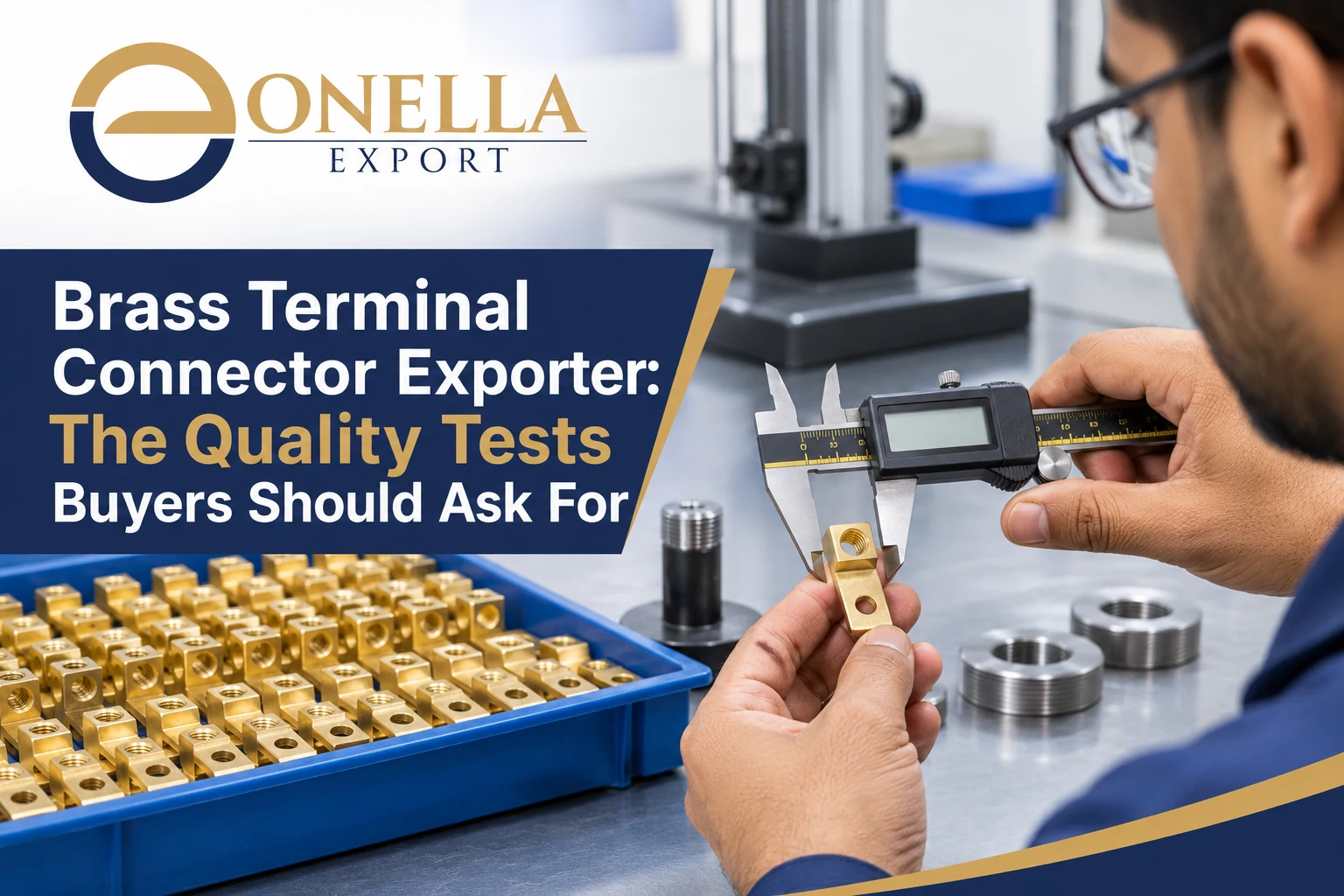
Onella Export checks threads with go/no-go gauges and dimensions with measuring instruments and optical comparators, and provides inspection reports and material certificates on request. See our quality approach.
Common Mistakes
- Approving bulk production without first article inspection
- No agreed sampling plan
- Assuming component suppliers perform product-level electrical tests
Key Takeaways
- Agree component tests and sampling before production.
- Product-level electrical tests usually remain with the equipment maker.
- Keep approved samples and inspection reports for every lot.
Example: Catching a Thread Problem
During incoming inspection, an importer found that a lot of terminals failed the go-gauge on a few parts. Because the inspection report listed the lot and gauge results, the exporter traced the issue to a worn tap, replaced it and added an extra in-process check. The problem was fixed before it reached the assembly line.
Questions to Agree Before the First Order
- Which dimensions are critical, and how will they be measured?
- Which sampling plan applies?
- Which reports and certificates come with each lot?
- How will non-conforming lots be handled?
The Bottom Line
Clear test agreements protect both buyer and exporter. They turn quality from a hope into a routine.
Next Steps
Mark critical features on your drawing and share your sampling and reporting needs with every supplier you are evaluating. Ask each one for a sample inspection report from a recent lot, so you can see exactly what they measure and how results are recorded before you place an order.
About Onella Export
Onella Export has manufactured and exported brass components from Jamnagar, Gujarat since 1991. It is an ISO 9001:2015 certified manufacturer with its own foundry producing around 5,000 kg of brass solid and hollow bars a day, plus in-house forging and machine turning. Customers are spread across India, the Middle East, the Far East, Europe and America.
Related Reading
- Brass terminal connectors: types, specs and export packing
- Brass neutral links: OEM supply programmes for panel builders
- Importing brass components from India: MOQ, lead time and documentation
Frequently Asked Questions
Which quality tests apply to brass terminal connectors?
Dimensional inspection, thread gauge checks, visual inspection, material composition, plating thickness and adhesion, screw torque and corrosion resistance tests.
Who does temperature rise testing for terminals?
Usually the maker of the finished terminal block or device, or a test laboratory, under the relevant product standard.
What is first article inspection?
Measuring every drawing dimension on sample parts before bulk production and keeping approved samples as references.
What should an inspection report include?
Lot number and quantity, measured critical dimensions, thread gauge results, plating thickness and material certificate reference.
Can I use third-party inspection for exports?
Yes. Many importers appoint independent agencies; agree access and timing with the exporter in advance.
Agree a Quality Plan for Your Terminals
Contact Onella Export with your drawing, sample or specification, email kp@onellaexport.com or call +91 97276 77787.